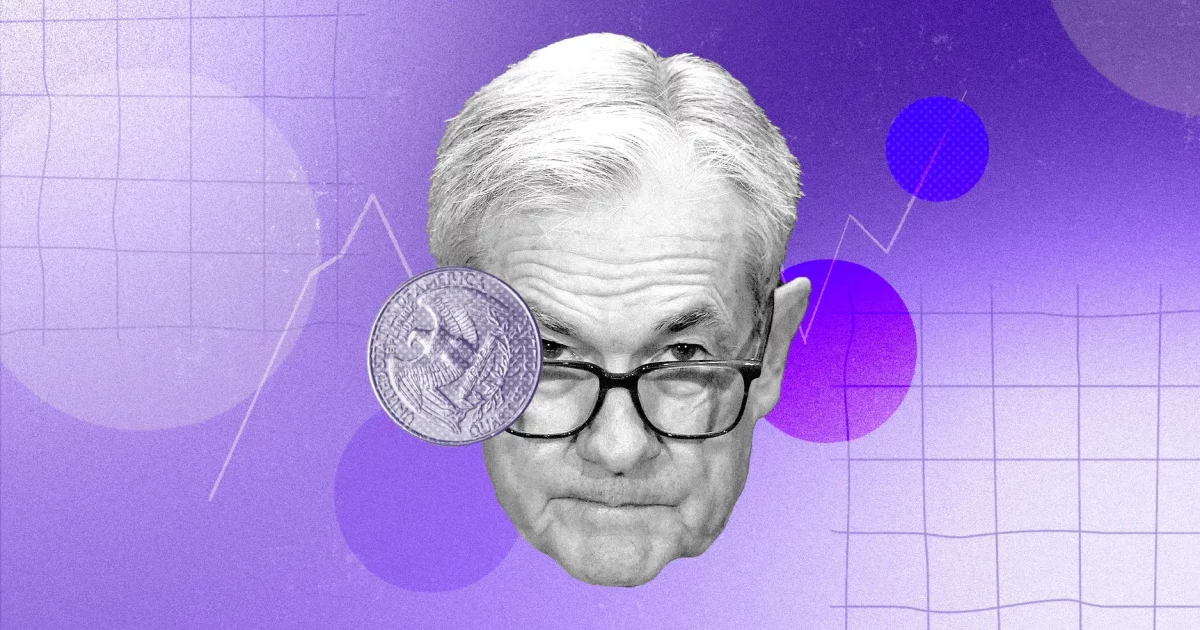
Minutes before addressing Congress, Jerome Powell was seated alone in a wooden-clad chamber, deep in thought.
The Fed president was ready for questions about the central bank’s main functions of maintaining low inflation and employment, despite anticipating criticism.
Senator Bernie Moreno, a Republican supporter of President Trump, criticized Powell during the hearing for linking Trump’s tariffs to potential price increases and economic slowdown, accusing her of being partisan. Powell responded by clarifying that she only comments on inflation, not tariffs.
Moreno disregarded him and claimed that inflation was decreasing, reflecting a statement made by Trump. The president insisted on a prompt reduction in interest rates, criticizing Powell for not following the directive and questioning his integrity and intelligence, referring to him as stubborn and foolish. Trump was the one who appointed Powell to the role in 2017.
Moreno emphasized that he was chosen by millions of voters as his term came to a close. He pointed out to Powell that Powell had been selected by just one individual who did not support Powell’s role. Powell raised an eyebrow, silenced the microphone, and shifted focus to the next senator’s inquiries.
The Fed president faces criticism daily, particularly from Trump, who believes inflation is under control and that the economy is prepared for a decrease in interest rates. Powell and others prefer to take a wait-and-see approach.
Powell’s remarks at the yearly economic conference in Jackson Hole, Wyoming, will be closely watched by investors and policymakers in Washington. Anyone involved in the market, including almost everyone with a wallet, should pay attention to hints about potential interest rate decreases.
Surviving in the Federal Reserve
Powell believes that the Federal Reserve’s continued existence as an independent central bank, crucial for the country’s prosperity, hinges on how he navigates the current economic situation.
Those who closely collaborated with him note that he mainly concentrates on making correct decisions, drawing from the experience gained in managing the Fed during the pandemic and subsequently being cautious in addressing the severe inflation peak in decades.
Richard Clarida, who served as the Fed’s number 2 during Powell’s first term, believes that Powell is constantly focused on preserving the institution.
Political pressure peaked in an unusual way when Trump unexpectedly visited the Fed headquarters reform project last month, with White House advisors spending weeks accusing Powell of budget overruns.
Trump and Powell, both in white helmets and suits, inspected the dusty construction site. Trump motioned for Powell to come forward in front of the television crews, announcing that the expenses for renovating two historic buildings had increased from $2.5 billion to $3.1 billion.
Powell disagreed with Trump’s statement after examining the print copy provided by the White House team, pointing out that Trump had mistakenly included a third building that was already completed years ago.
Trump later changed his tone and mentioned that the meeting with Powell went smoothly. “There was no stress,” the president stated.
Trump is pushing for the governor of the Federal Reserve, Lisa Cook, to step down promptly amid allegations of mortgage fraud prior to her appointment. He is contemplating firing Cook, who aligned closely with Powell, to create a vacancy for his own appointment.
Cook stated that he has no plans to be forced to step down from his role. He is committed to addressing any inquiries regarding his financial past at the Federal Reserve seriously by collecting precise information to respond to valid questions and present the facts. Powell, who was educated by the Jesuits, heads an organization that can be easily critiqued by politicians because, similar to the Vatican, the Fed holds power without a military force.
Powell swims three times every week.
Powell mentioned to colleagues that, despite his advanced age, he does not feel burdened by stress. At 72 years old, he maintains the best physical condition of his life, engaging in swimming three times weekly and working out with a personal trainer. This routine assists Powell in managing stress, even though the gravity of decisions impacting millions of Americans can occasionally disrupt his sleep.
Powell receives strong support from various groups, including bipartisan lawmakers, bank leaders, and strangers who approach him in public places like airports or academic settings. He also receives letters expressing gratitude for his resolute stance.
“He possesses a strong understanding of his purpose and intentions in that role,” stated Jon Faust, who served as Powell’s senior advisor during his initial six years as Fed president.
During the congressional hearings, Powell evaded a query regarding political influence and emphasized his priority of maintaining a stable economy with controlled inflation. He stated, “My main concern is passing on the position to my successor in these circumstances; that’s all I am focused on.”
The economic challenge, along with partisan political pressures, would be a significant test for any Fed president.
The economy is in decline.
The Federal Reserve’s tool of adjusting interest rates is a versatile method for managing a complex economy worth $30 trillion, balancing the risks of recession from raising rates too high and inflation from lowering rates excessively.
Powell must navigate an economy dealing with the uncertainties of Trump’s trade policy and the influence of artificial intelligence. The repercussions of tariffs and AI remain unclear, impacting how businesses hire and set prices. The Federal Reserve’s choices will impact Americans’ purchasing power and the relationship between wages and expenses.
Inflation has exceeded the Federal Reserve’s 2% target for the past four years. Officials are concerned that tariffs may prompt businesses to raise prices, leading to sustained high inflation.
Economic policymakers are concerned about the long time it takes for the US labor market to recover after a recession. The unpredictability of post-pandemic employment trends, as well as fluctuations in company formation and immigration, make it challenging to forecast labor demand.
“They are facing a challenging situation as they are expected to be delayed in completing the job, considering the recent downward revisions,” stated Diane Swonk, KPMG’s chief economist. “Inflation is likely to worsen before improving.”
Recent economic data indicate a challenge, as the underlying inflation, which had been decreasing last year, has risen from 2.6% to 3% this year.
The expansion of employment slowed significantly in the quarter ending in July, with notable declines in the figures for May and June, while the unemployment rate stayed near 4.2%.
The slowdown in hiring aligns with shifts in Trump’s policies, such as crackdowns on immigration, tariffs, reductions in federal jobs and spending on contractors and non-profits. The Trump administration argues that tax cuts and deregulation may offset some of these challenges.
Fee maintenance
Most of the Federal Reserve officials backed keeping interest rates unchanged last month, but two governors, Christopher Waller and Michelle Bowman, advocated for a decrease in rates. Waller and Bowman, who were appointed by Trump, are potential candidates to lead the Fed after Powell’s term concludes in May.
Waller cautioned that the apparent employment growth is not as strong as it appears, pointing out certain indicators are “in the red zone.” He suggested that policymakers should not base their decisions on interest rates solely on price hikes related to tariffs, as it is unlikely to recur.
Bowman stated in a review of Powell that the Federal Reserve’s choices have lacked uniformity.
chsyys/FreeImages
She pointed out that the current state of the real estate market, consumer spending, and the employment rate for active-age individuals is not as strong as it was last year when the Fed started reducing rates. Advocates for inflation, however, are on the opposite side of the argument regarding interest rate cuts.
Jeff Schmid, the Kansas City Fed chairman and a voting member of the interest-rate committee, stated in a recent speech that inflation tariffs had a limited impact due to the Fed’s cautious approach in adjusting rates. He expressed a desire for continued uncertainty regarding tariff effects on prices in the coming months.
Powell’s work
Powell must unify differing opinions and steer them in his desired direction, possibly using economic data as a guide.
The July employment report showed more obvious signs of a weak labor market, possibly giving Powell a reason to decrease interest rates next month.
The job market is currently satisfactory, according to Mary Daly, the President of the Federal Reserve Bank of San Francisco. However, she expressed concern that the trend is moving in the wrong direction.
She also mentioned that tariffs are not increasing prices as significantly as some analysts anticipated, lessening the likelihood of a significant shock.
Minneapolis Federal Reserve President Neel Kashkari suggested that the Fed might need to lower interest rates immediately to bolster the job market and consider reversing these actions if inflation resurfaces. Kashkari expressed his reluctance towards this approach but acknowledged it as potentially the most favorable choice among limited alternatives.
Alberto Musalem, president of the St. Louis Fed, and Austan Goolsbee, president of the Chicago Fed, indicated a surprising rise in service prices, hinting at a potential fee upkeep despite Musalem highlighting slower economic growth that may lead to a future interest rate reduction.
vulnerabilities
Fed’s independence goes beyond any single leader, making it difficult for Trump to influence even if Powell is replaced with a more favorable candidate.
Powell protected his colleagues and his bond with them at the Fed is likely stronger due to the challenging circumstances faced by the institution and the president.
Some people view Trump’s strong criticisms of Powell as less risky than the prospect of a White House effort to undermine the Federal Reserve’s system, which includes the 12 central banks.
The meetings to set interest rates include 12 bank presidents and a council of seven governors, with five presidents having voting rights. Unlike Fed governors appointed by the president, regional bank presidents are selected by local councils and typically work independently of Washington.
Federal Reserve presidents serve five-year terms that run concurrently. The 12 presidents must be reappointed by the governors for new five-year terms before March of the following year. While a Federal Reserve board has the authority to remove a regional bank president with a majority vote, this has never been done.
The White House appoints governors, leading to concerns about the potential for a council controlled by Trump to hinder the reappointment of Fed presidents.
A Trump administration official suggested that Cook, a Federal Reserve governor appointed by Biden, may have engaged in mortgage fraud by applying for loans for two properties she claimed were her primary residence.
Trump selected one of his economic advisors to fill the position of a Federal Reserve governor who unexpectedly resigned this month. If another governor departs ahead of schedule, the president could nominate a supporter, thereby securing a majority on the board with his appointees.
Another form of stress
Treasury Secretary Scott Bessent, a former hedge fund investor with expertise in monetary policy, exerted additional pressure on the Fed last week as he leads the search for the next president of the organization.
Bessent stated in a television interview that the Federal Reserve should contemplate a larger half-point rate cut in September and further decrease its current interest rate of about 4.3% to below 3%. This led to heightened expectations among investors for a half-point rate cut.
Bessent not only shared his views but also appeared to create a challenging position for Powell. If investors act based on the belief that a significant interest rate cut is more likely due to the Treasury Secretary’s remarks, Powell faces the possibility of market disappointment and being held responsible for any substantial sell-off if the Fed does not follow through.
Bessent stated in an interview the next day that he did not instruct the Federal Reserve on what to do.
Translated by InvestNews
Presented by